When the Road Starts Thinking – The BME Department of Automotive Technologies Presents the Future of Intelligent Transport Infrastructure at the QFD Conference
Transport infrastructure is not necessarily just the environment in which vehicles operate: with appropriate sensing, data processing and a digital twin, the road itself can become an active, intelligent part of the mobility system. This was the subject of a presentation by Dr. Zsolt Szalay, Associate Professor and Head of the BME Department of Automotive Technologies, at the 15th Regional Automotive Supplier Conference, where the Department also welcomed participants with a live VR demonstration of the M1–M7 smart road digital twin.

The BME Department of Automotive Technologies actively participated in the 15th Regional Automotive Supplier Conference organised by QFD Group in Budapest on 29–30 September 2026. The event brings together automotive decision-makers, OEMs and Tier 1–2 suppliers, as well as representatives of engineering, development and management functions. In addition to industry trends and technological and quality-related challenges, the two-day programme placed strong emphasis on the automotive solutions of the future.
The Department’s participation focused on intelligent transport infrastructure and the digital twin of the M1–M7 smart road. Dr. Zsolt Szalay delivered the conference’s opening plenary presentation, entitled “When the Road Starts Thinking – The Role of Intelligent Transport Infrastructure in Automated Mobility.” In connection with the presentation, participants could also experience the real-time digital twin of the M1–M7 smart road section in a VR environment throughout the day.
What happens when not only the car sees the road?
Dr. Szalay’s presentation started with a simple question: Who sees the road?
For road users, it seems natural that the driver, or the vehicle, perceives the environment. The vehicle’s cameras, radars and LiDAR sensors observe the world around it and use this data to build a model of the traffic situation. This approach, however, has an inherent limitation: the vehicle can primarily work with what it is able to perceive from its own position.
A larger vehicle can obscure the traffic ahead. A bend or a roadside object can conceal an event farther down the road, while in an urban environment, a building may obstruct the detection of a traffic situation developing across an intersection.

What would change if the infrastructure itself could also perceive traffic?
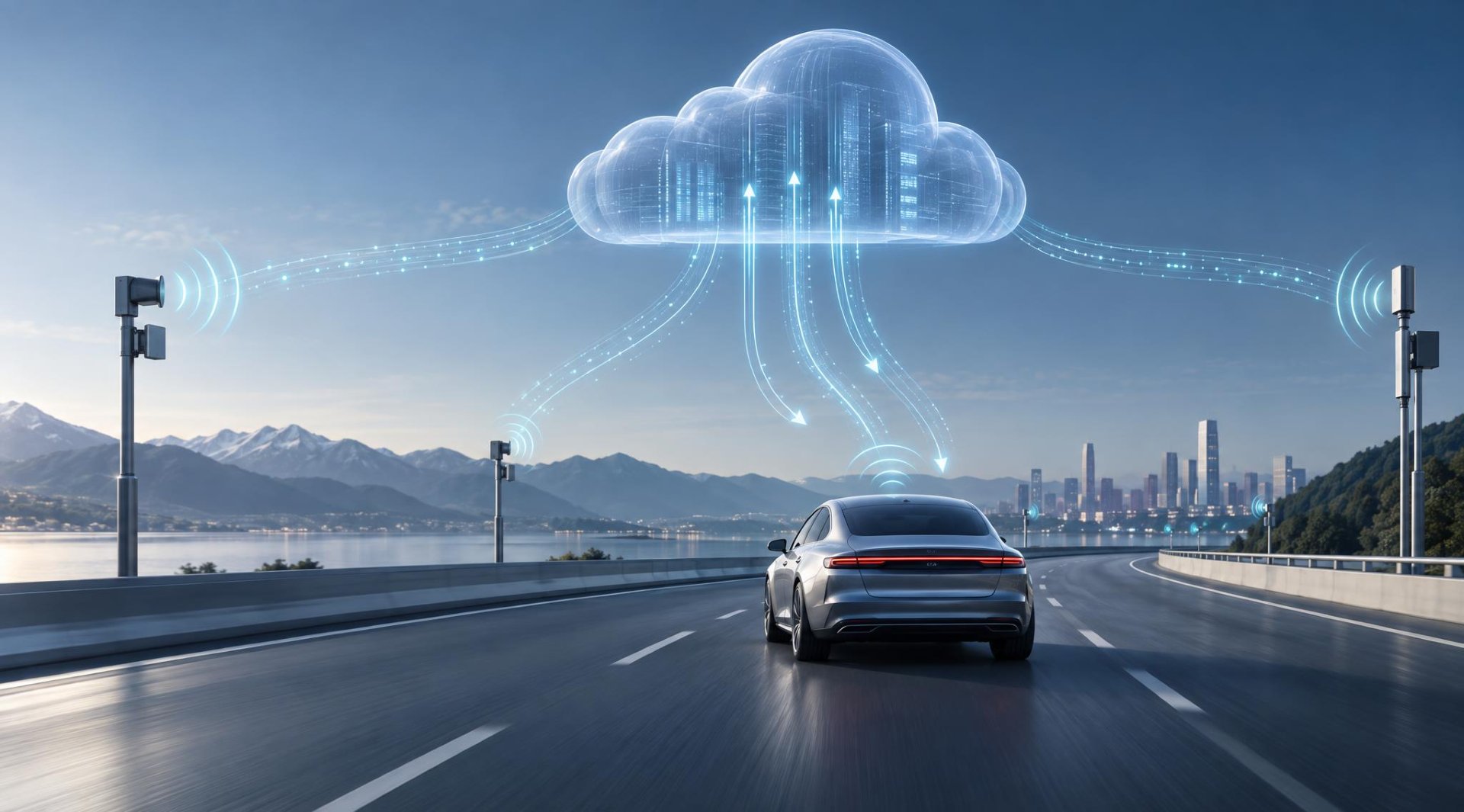
A suitably sensor-equipped road section can observe traffic from a different perspective. Rather than seeing only the immediate surroundings of a single vehicle, it can observe events across an entire road section and process data from different sensors together. This can provide information about traffic situations developing hundreds of metres farther ahead or behind.
This change in perspective leads to the concept of intelligent infrastructure: a public road is not merely the physical environment of vehicles, but can also become part of the sensing and information layer of the mobility system.
The M1–M7 as a real-world research platform
The practical implementation of this concept is demonstrated by the M1–M7 smart road project, in which the BME Department of Automotive Technologies and Magyar Közút equipped an approximately 1.5-kilometre road section with a high-density sensing system.
The road section combines three types of sensing technology: 23 LiDAR sensors, 26 RGB cameras, 10 radar sensors and 10 thermal cameras monitor the traffic environment. The system generates approximately 25 gigabit of data per second, meaning that the data cannot be processed by relying exclusively on a centralised cloud infrastructure. Edge computing capacity deployed along the road complements the cloud-based architecture.
The concept is not limited to data originating from the infrastructure, either. The system can also integrate information from vehicle sensors using wireless communication. This allows the environment perceived by the infrastructure and that perceived by vehicles to become part of a common information system.
In developing the system, the Department also applies standardised data models and communication solutions, including solutions related to the ADASIS and SENSORIS standard families.
From data to a digital twin
One of the most important outcomes of the system is the digital representation of the real road section – the digital twin.
A digital twin is not simply a three-dimensional model. In the case of the M1–M7, real-time detected traffic objects are placed within a highly accurate, static map environment. The static map was created using laser scanning and provides a centimetre-level geometric representation of the road section. On top of this, a dynamic layer of continuously changing traffic information is added.
The physical structure of the road and the traffic taking place on it can therefore be represented simultaneously within the digital environment.
One of the system’s important characteristics is its real-time operation. The Department applies its own artificial-intelligence-based sensor-fusion and vehicle-detection solutions. Information from the different sensors is fused at several levels, and the system can detect vehicles across the entire road section in approximately 30 milliseconds. The complete processing cycle currently takes around 100 milliseconds, allowing the full situation picture to be updated twenty times per second.
This speed enables the digital twin to be more than a retrospective data visualisation: it becomes a system that remains temporally connected to the real traffic situation.

The intelligent road as a digital laboratory
According to Dr. Szalay, one of the most important potential applications of such infrastructure is testing.
Automated-driving and driver-assistance systems are currently typically developed and validated in several stages: in simulation environments, on test tracks and finally in real-world traffic. Real-world traffic testing, however, is costly and time-consuming, while rarely occurring but important traffic situations are difficult to reproduce in a controlled and repeatable manner.
Intelligent infrastructure offers a new possibility here. The M1–M7 smart road can provide highly accurate ground truth, or reference information, in a real traffic environment. This makes it possible, for example, to validate the perception of driver-assistance systems in real time.
The digital twin can take this one step further: real traffic situations can be replayed, repeated and modified virtually. Automated-driving functions under development can therefore be examined not only in simulated, artificial environments, but also using a digital representation of a real road section and real traffic.
In this model, physical and virtual testing are not alternatives to one another, but complementary methods that reinforce each other.
The Department is already investigating this possibility in international collaborations: using simulators at partner universities, it is possible to connect to the current traffic environment of the M1–M7 road section, while the simulated vehicle perceives the representation of real traffic within the digital environment.
The road that remembers
Continuous data collection gives infrastructure another important capability: the road can not only see, but also remember.
If the traffic on a road section is observed over an extended period, the result is not merely a series of isolated traffic events, but a collection of recurring patterns.
It becomes possible, for example, to observe how traffic changes on Monday mornings and Friday afternoons, how rain or fog affects traffic, where congestion regularly develops, and what kinds of traffic situations precede these events.
This makes it possible for the system not only to describe the current traffic state, but also to learn from recurring situations.
Based on large volumes of data, models can also be developed that, initially under human supervision and potentially in the longer term automatically, could support traffic interventions.
A New Dimension to Accident Investigation
A digital twin can also enable an approach to accident investigation that differs fundamentally from conventional on-site procedures. When continuously recorded data from multiple sources are available for the traffic environment, the precise course of an accident can not only be reconstructed afterwards, but its preceding events can also be reviewed and analysed. This means that an investigation does not have to rely exclusively on traces recorded after the accident, the vehicles involved, and witness statements: a digital twin can provide objective, time-stamped and retrievable information that offers a more precise picture of what happened in the seconds leading up to the accident and during the event itself. Another practical benefit could be that traffic restrictions and road closures required for on-site data collection could be partly or even entirely avoided. In this way, a digital-data-based approach to accident investigation could also reduce the time and cost losses resulting from traffic disruption caused by accidents.
We do not need an accident to happen in order to learn from it
One particularly important potential of the digital twin is that lessons do not have to be drawn exclusively from accidents that actually occur.
The same traffic situation can have several possible outcomes. A dangerous situation may lead to an accident on one occasion, while on another occasion the participants may avoid a collision. Such near-miss situations – incidents that almost resulted in an accident – can themselves contain valuable information.
In the M1–M7 system, continuous tracking of the movement of traffic objects makes it possible to identify and analyse such situations. In aviation safety, learning from near misses has long played an important role; intelligent road infrastructure could enable a similar approach in road transport.
Data collected over a longer period can also reveal where and why critical situations repeatedly develop on a particular road section. The knowledge gained in this way can be used not only in operating the given road section, but can also provide valuable input for future infrastructure development and design decisions.
The future cannot simply be predicted – but it can be recognised earlier
The next step discussed in the presentation was prediction.
According to Dr. Szalay, for an intelligent mobility system, the most important objective is not necessarily to “predict the future”. It may be much more important to identify as early as possible the patterns that are likely to lead to congestion, dangerous situations or other undesirable traffic events.
If a change can be detected early enough, intervention can also take place earlier and more preventively.
This is no longer simply traffic monitoring, but decision support: the infrastructure may not only know what is happening, but also indicate the direction in which the traffic situation is developing.

Infrastructure can also extend the capabilities of the car
The digital twin and intelligent infrastructure do not necessarily benefit only the most advanced vehicles.
One of the directions pursued by the Department is to make situation information originating from the infrastructure available through a mobile application also to vehicles that have less advanced sensing capabilities, or no such systems of their own.
Such a solution could, for example, display the position and movement of vehicles detected by the infrastructure even when the vehicle’s own sensors are blocked by another vehicle. This could open up new possibilities in areas such as blind-spot warnings, following-distance recommendations or speed recommendations designed to help prevent dangerous braking waves.
The system could also provide personalised traffic information. Instead of every road user receiving the same general message, the infrastructure could potentially formulate recommendations tailored to the position of individual vehicles.
The next stage of development could be reached when the mobility system not only provides information, but also takes an active role in optimising traffic – for example, by recommending a lane change to some vehicles and a change in speed to others.
New capabilities, new opportunities for suppliers
Technological development also raises an important question for the conference audience, particularly automotive suppliers.
In an intelligent mobility system, value is increasingly created not by individual components in isolation. Sensors, communication systems, computing capacity, artificial intelligence, digital twins and the services built on them jointly create new capabilities.
This may also transform the supplier ecosystem: a component increasingly becomes an enabler of a capability within a larger system.
The supplier of the future will therefore need to do more than deliver a component. Increasingly, suppliers will need to provide technological capabilities, expertise and solutions that can be integrated into a larger system and create value in their own right.
This is particularly important in emerging fields such as intelligent infrastructure, cooperative perception, digital twins, traffic data processing and automated mobility.
Entering the M1–M7 digital twin
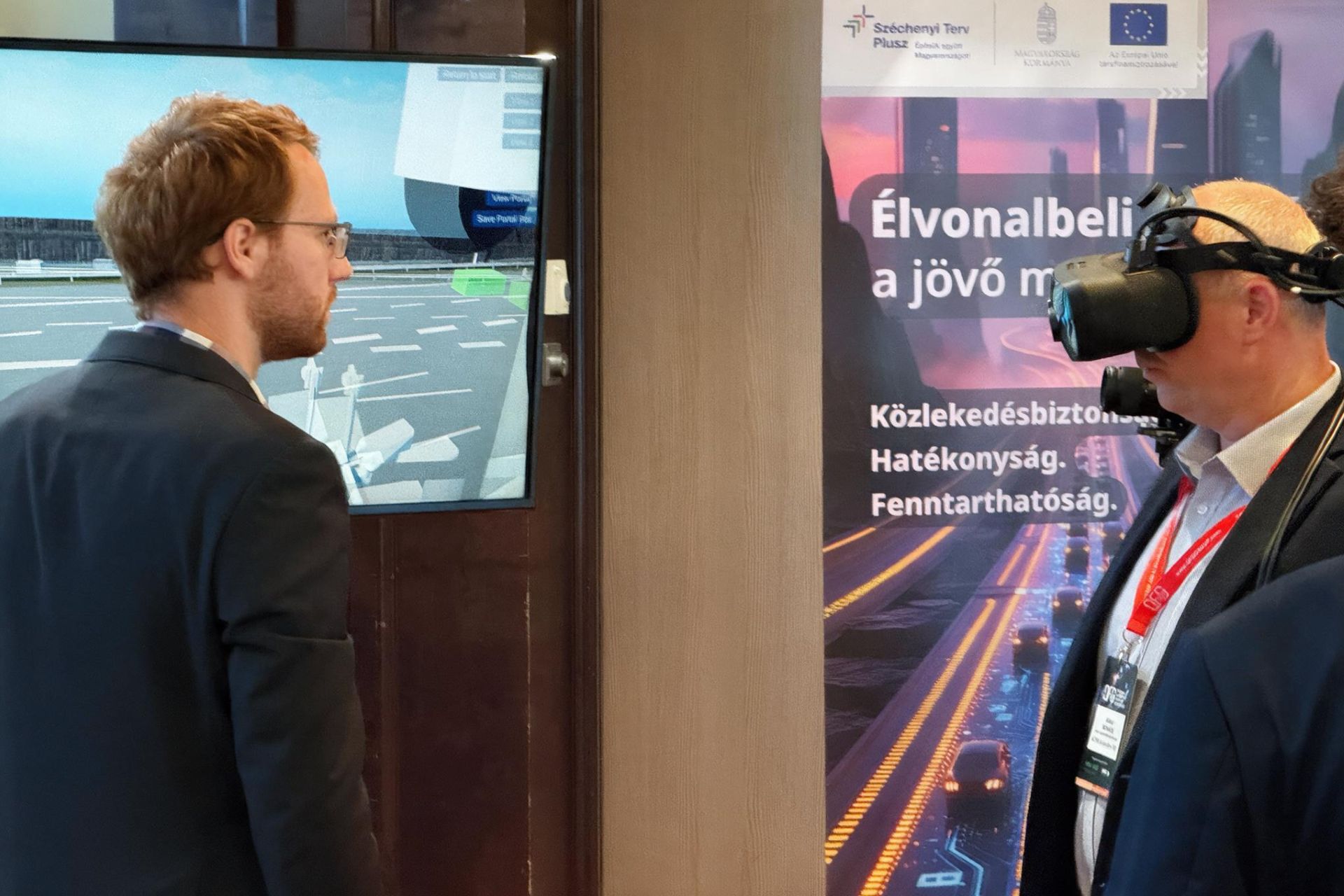
Conference participants could not only hear about intelligent infrastructure in the presentation: at the BME Department of Automotive Technologies’ demonstration area, they could enter the M1–M7 smart road digital twin through a live VR demonstration.
Using VR headsets, visitors could move through the spatial environment of the digital representation of the road section, surrounded by vehicles and traffic events appearing in synchronisation with real-world traffic. The demonstration thus provided a direct experience of one of the digital twin’s essential characteristics: it is not a static 3D model, but a dynamically changing representation based on real-time data streams.
The VR demonstration was part of the QFD Group conference programme throughout the day in the exhibition area, directly complementing Dr. Szalay’s plenary presentation.
The road as an active part of the mobility system
The final message of Dr. Szalay’s presentation was that the development of automated mobility should not be viewed exclusively from the perspective of the vehicle.
Alongside increasingly intelligent vehicles, infrastructure itself can acquire capabilities for sensing, data processing, situation awareness, learning and decision support. The digital twin built on these capabilities can then create a shared information environment for vehicles, infrastructure, road users and service providers.
The next step, therefore, may not simply be an even smarter car.
We are increasingly moving towards a smarter mobility system.
The M1–M7 smart road and digital twin research programme of the BME Department of Automotive Technologies provides a research and demonstration platform for exploring this approach in a real traffic environment. The project simultaneously supports research into intelligent infrastructure, automated mobility, digital-twin-based validation and the future development of the mobility system.
